

 Spine Support


“This guide compares passive cooling and active cooling mattresses, explains how each technology works, breaks down their pros, cons, costs, maintenance needs, and real-world performance, and helps hot sleepers choose the right cooling solution based on sleep temperature, bedroom environment, partner needs, and budget.”
Nothing beats turning your pillow to its "cold side" for the third time in an hour, only to find it warm again within minutes. Night sweats, overheating, and the like aren't petty nuisances for millions of hot sleepers—they're the enemy of deep, restorative rest. With the evolution of mattress technology, there are two primary types: Passive Cooling and Active Cooling.
But with buzzwords like "phase change materials", "thermoelectric chillers", and "breathable graphite" floating about, how do you determine which technology is worth your investment? In this guide, we will clarify the science, the price tags, and the in-the-field operation of passive versus active cooling techniques, allowing you to find your ideal sleep temperature — without it being a workout.
What is Passive Cooling?
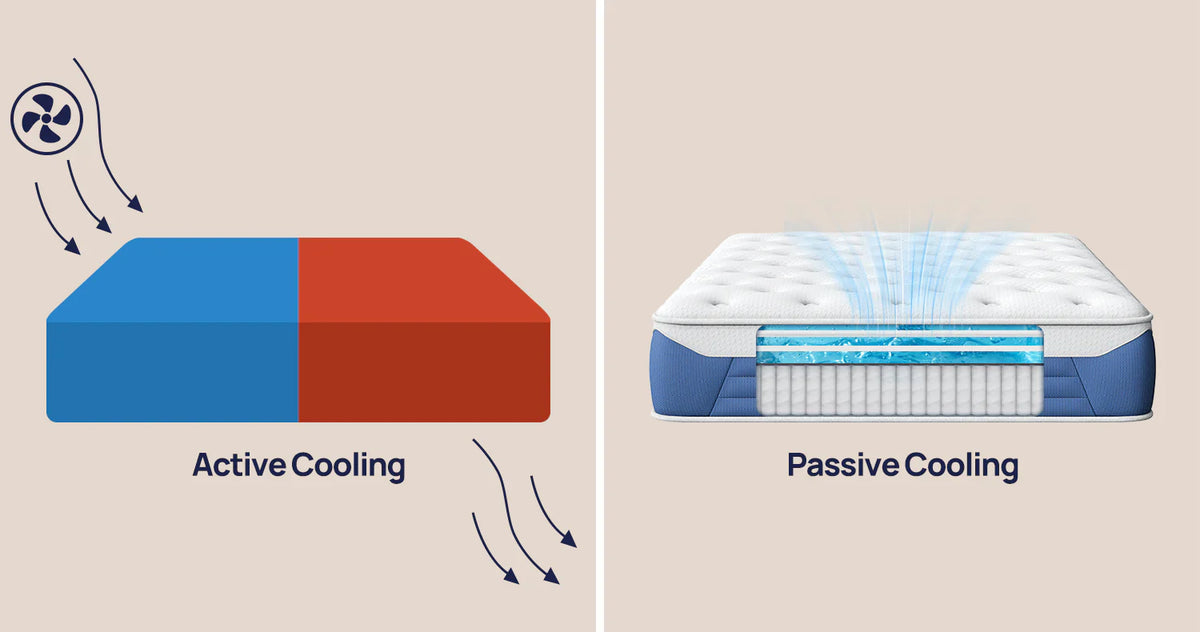
Passive cooling means having new materials and construction methods that will absorb body heat without any electricity and without moving parts. Imagine comparing it to a well-ventilated cotton shirt versus a plastic raincoat. Passive mattresses don't create cold; they simply facilitate the cooling of heat away from your body efficiently.
Popular Passive Cooling Technologies
The ubiquitous method. Memory foam is coated with gel beads or swirls in order to enhance heat conductivity, pulling some heat out of the body and spreading a large part of it.
They are considered the top-rate passive cooling material. PCMs are tiny capsules (typically paraffin wax or salt hydrates) inserted in the fabric or foam. When you get hot, the solid melts (like a sheet of ice melts into water), absorbing a good amount of heat in the process. When you cool down it becomes fixed in place again and releases the heat. PCMs don't 'run out' -- they recycle.
Natural fibers are very hydrophilic, which means they wick moisture away through the skin and move moisture away (sweat). It is a cooling process that vapours water into the mattress surface (such as the layer sheath). Then those layers can help to regulate temperature passively.
Latex has an open-cell feature. So instead of being held shut down like memory foam, the mattress lets air pass between cells freely through it. Talalay latex is especially breathable.
These conductive metals pull heat away fairly quickly from the body and move it along the mattress's surface.
📖Recommended Reading: Does Cooling Technology Really Work?
PASSIVE COOLING
Material-based cooling without electricity.
“Passive cooling uses materials and construction methods to absorb or move body heat away without electricity or moving parts. It does not create cold; it helps heat leave the sleep surface more efficiently.”
PROS
- No electricity requirement: Works even during a power outage.
- Silent sleep: No fans, pumps, compressors, or bedside console noise.
- Low maintenance: Nothing to refill, clean, connect, or replace.
- Durable design: Fewer electronic parts means fewer failure points.
- Budget-friendly: Usually adds hundreds to the mattress price, not thousands.
CONSIDERATIONS
- Limited cooling capacity: Extreme hot sleepers may overwhelm passive materials.
- Shorter peak effect: Cooling can feel strongest in the first 30–60 minutes, then plateau overnight.
- Room-dependent: Works best when the bedroom is already cool and well ventilated.
- Less ideal for heavier sleepers: Deeper sinkage can reduce surface airflow and cooling.
Best For:
- Warm sleepers rather than “soaking wet” sleepers
- Shoppers with an $800–$1,500 budget
- People who sleep alone or share similar temperature preferences with a partner
- Bedrooms with AC and steady airflow
- Sleepers who want quiet, low-maintenance cooling
What is an Active Cooling Mattress?
Active cooling is precisely what it sounds like: a system that uses energy to actively remove heat from the sleeping surface. These are high-tech devices that simulate air conditioners or refrigeration for your bed. Active systems push, pull, or pump heat out, instead of sitting around passively waiting for all the heat to slowly recede or fall off the surface.
Types of Active Cooling Mattresses
Active cooling mattresses primarily rely on two technologies: air circulation systems and water cooling systems. However, other devices are also popular in active cooling mattresses. Let's take a look.
Air-Circulation SystemsMattresses with internal fans or "beds of nails" construction (i.e., the Eight Sleep Pod or BedJet). They pull cool room air back into the mattress and push warm air out. Some are built into the mattress; others are toppers or add-on items.
Water-Based SystemsThey feature a hydronic pad (thin tubes containing water) placed on top of your mattress and then connected to a console unit that heats or cools the water (Eight Sleep Pod Cover, ChiliPad / Sleepme Dock Pro). Water has a very high specific heat capacity, so it can carry away a tremendous amount of thermal energy.
Thermoelectric Coolers (TEC)Most water-based systems actually have a TEC (Peltier device) in the console to cool the water. Solid-state TEC mats occur on occasion, but are more limited for full mattresses.
Ventilated FoundationsAdditional adjustable beds have a fan deck below the mattress that pushes air up through the foam layers.
ACTIVE COOLING
Powered cooling for stronger temperature control.
“Active cooling uses powered systems to remove heat from the sleep surface. Instead of waiting for heat to dissipate naturally, it uses air, water, or thermoelectric technology to push, pull, or pump heat away.”
PROS
- High cooling power: As long as there is power, the system can keep cooling for extended periods.
- Dual-zone control: Many systems let each side of the bed use a different temperature.
- Programmable comfort: Pre-cool the bed, warm it in the morning, or adjust temperature through the night.
- Consistent performance: Can work better than passive cooling in hot rooms or during summer nights.
CONSIDERATIONS
- Higher cost: Full active cooling systems often cost $1,500–$4,000+.
- Noise and electricity: Consoles, pumps, or fans may create a low hum or airflow sound.
- Maintenance required: Water-based systems may need refills, cleaning, and leak checks.
- More complexity: Tubes, connectors, pumps, and electronics create more potential failure points.
- Installation needs space: Many systems require a bedside console or extra setup.
Best For:
- People with severe night sweats
- Hot or humid bedrooms without effective bedroom cooling
- Couples with different sleep temperature preferences
- Shoppers willing to spend over $2,000 for precise thermal regulation
- People comfortable with a low hum, bedside console, and occasional maintenance
A Comparison Table: Which Performs Better?
A basic understanding of passive cooling and active cooling mattresses. You may have a question, which one performs better and which one is right for me? Frankly, there's no best of either, only right for you. Both passive and active cooling have pros and cons, none of which is the best of worlds.
| Feature | Passive Cooling | Active Cooling |
| Initial Cost | $500-1000 (premium model) | $1500-4000 |
| Operating Cost | $0 | $30-100+ per year |
| Cooling Power | Moderate; finite capacity | High; unlimited runtime |
| Noise Level | Silent | Low hum or fan noise (2045 dB) |
| Maintenance | None | Water changes, cleaning, leak checks |
| Best For | Mild to moderate hot sleepers, budget conscious | Severe night sweats, couples with different preferences |
| Lifespan | 8-10 years (no electronics) | 5-8 years (electronics may fail sooner) |
How to Choose the Right One?
Use this simplified checklist to decide whether passive cooling or active cooling is the better fit for your sleep needs.
How hot do you truly sleep?
If you wake up in damp sheets or overheat even when the room is cool, passive cooling may not be enough. If you only feel a little warm in summer, a passive mattress with PCM, latex, or breathable materials may solve the issue.
How does the inside of your bedroom appear?
If your room stays around 65–68°F with AC and good airflow, passive cooling can work very well. If your room is hot, humid, or poorly ventilated, active cooling can create its own cooler sleep microclimate.
Do you sleep with a partner?
If one person sleeps hot and the other sleeps cold, active cooling with dual-zone control is usually the better choice. If both sleepers prefer similar temperatures, passive cooling is simpler and more practical.
What is your budget?
Active cooling systems usually cost much more and require power, space, and maintenance. Passive cooling mattresses are more budget-friendly for shoppers who want cooling comfort without pumps, fans, or bedside consoles.
Final Thoughts
Passive and active cooling mattresses solve the same problem in very different ways. Passive cooling is the simpler, quieter, and more budget-friendly choice for warm sleepers who mainly need breathable comfort, while active cooling is better for severe night sweats, hot bedrooms, and couples with different temperature needs. The best choice is not the most advanced option, but the one that matches your sleep environment, heat level, maintenance tolerance, and budget.
FAQs
An active cooling mattress works by using powered solutions, such as fans, water circulation systems, or thermoelectric units, to intentionally expel heat. On the other hand, the passive cooling mattress is made using breathable materials like latex, cotton, or wool, along with moisture-wicking fabrics, to keep you comfortable without needing electricity.
For those of you who sleep really hot or sweat a lot at night, then you'll want to have an active cooling mattress, as it delivers even and consistent cooling to keep you dry—and it's adjustable as much as possible. Conversely, passive cooling mattresses are better for those who feel mildly to moderately warm through the night.
Most passive cooling mattresses are effective, but the effectiveness of these types of mattresses relies significantly on the environmental conditions of the individual room such as temperature, humidity, and ventilation. Under consistently hot and humid conditions, an active cooling mattress would be the better choice for keeping you comfortable.
Passive cooling mattresses require less maintenance because they are made from durable, breathable materials and don't have mechanical parts. Active cooling mattresses, though, might require maintenance of components such as fans, pumps, or control units.
If you sleep in an area that is very hot, sweat a lot at night, or live in a particularly warm home, an active cooling mattress can be worth the money. Its adjustable cooling features, including water circulation, can provide relief that passive materials simply can't match. If you only feel too warm occasionally, a mattress with passive cooling features such as gel or latex may be enough.