

 Spine Support


“This guide explains the real difference between plush and firm mattresses, compares comfort, support, pressure relief, spinal alignment, motion isolation, cooling, and durability, and helps shoppers choose the right firmness based on sleep position, body weight, pain points, and personal comfort preferences.”
Have you ever wondered — or read — that "plush equals soft" and "firm equals hard"? What you really want is a proper mix of pressure relief and support for your body and overall sleep quality. By breaking it down into two basic categories — plush and firm — this guide helps you select a mattress based on your sleep positions, body weight, pain & health, and other factors.
First, Let's Define Plush and Firm Mattresses
On the standard mattress firmness scale from 1 to 10, most mattresses are rated between 3 and 8.
Plush mattresses: Extra Soft to Plush. (3 ~ 5 out of 10)
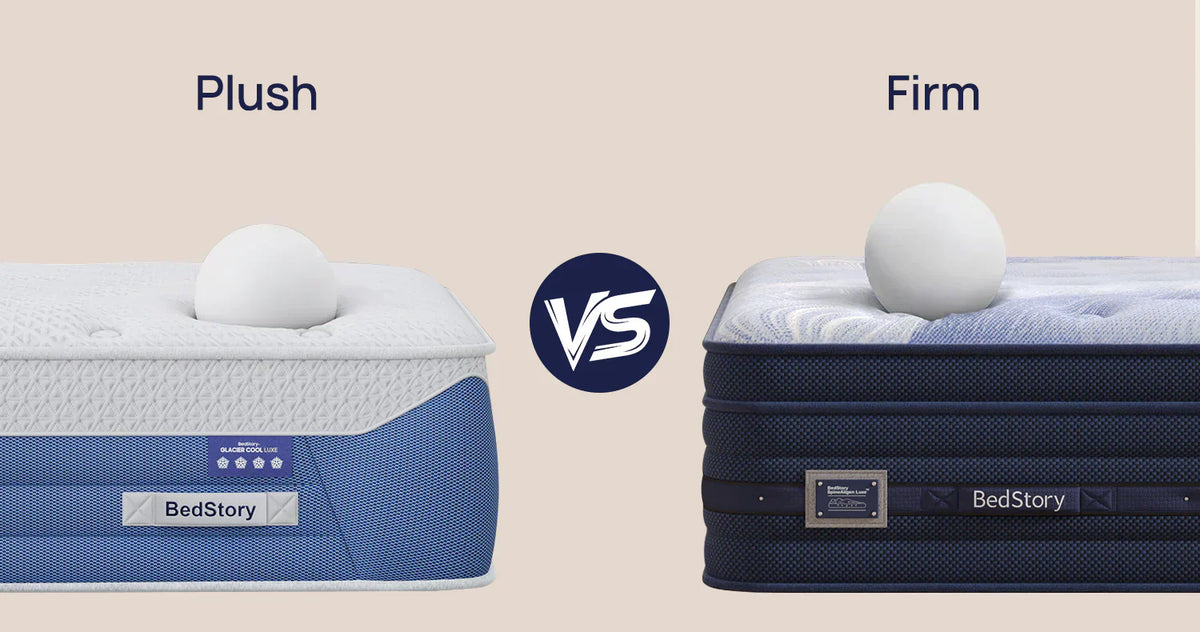
A plush mattress is typically rated 3 to 5 out of 10. It has a pronounced soft memory foam layer on the top. When you lie down, you sink in noticeably. The surface conforms to your curves — hips, shoulders, lower back — like a hug. Plush mattresses. They are almost always hybrids, such as foam + coils or all-memory foam.
Firm Mattresses: Medium-Firm to Extra-Firm (6 ~ 8 out of 10)
It is generally rated 6-8 out of 10 for a firm mattress. Firm mattresses provide strong support to prevent your body from sinking too much. They keep your spine straight and are a good option for back and stomach sleepers, people with back pain, or those with a heavier build. The surface resists compression. Medium-firm (6-7) offers some contouring; extra-firm (8+) feels hard to the touch.
PLUSH MATTRESS
Soft contouring comfort for pressure relief.
“A plush mattress feels soft and allows your body to sink in more noticeably. It cushions the shoulders, hips, and joints while still needing a supportive core underneath the comfort layers.”
PROS
- Soft, snug comfort: Creates a cushioned, cozy sleep surface.
- Better pressure relief: Helps relieve stress on shoulders, hips, and joints, especially for side sleepers.
- Great motion isolation: Comfort layers such as memory foam and latex absorb movement, making plush mattresses useful for couples.
CONSIDERATIONS
- Not ideal for many back and stomach sleepers: Too much sinkage may reduce lower-back support.
- May sleep warmer: Dense memory foam can retain heat if airflow is poor.
- Harder to move around on: Deep contouring and slow rebound can make turning over more difficult.
Best For:
- Primary side sleepers
- People with shoulder or hip pain
- Sleepers who like a hugged, cushioned feel
- Sleepers under 130 lbs
- Couples who need strong motion isolation
FIRM MATTRESS
Stable support for spinal alignment.
“A firm mattress is designed to keep your body more on top of the mattress instead of letting it sink too far down. The goal is stronger support, a straighter spine, and a more stable sleep surface.”
PROS
- Better spinal alignment: Helps keep the spine in a neutral position, especially for back and stomach sleepers.
- Strong support: Firm hybrid or latex designs with pocketed coils can reduce excessive sinkage.
- Cooler sleep: Less deep sinkage and stronger airflow can help create a fresher sleep surface.
CONSIDERATIONS
- Less pressure relief: Shoulders and hips may feel more pressure, especially for side sleepers.
- Can feel too hard: Side sleepers may feel discomfort if the mattress lacks enough cushioning.
- Less contouring comfort: Sleepers who prefer a soft hugged feel may find firm surfaces too rigid.
Best For:
- Back sleepers
- Stomach sleepers
- Sleepers over 230 lbs
- People who need stronger lumbar support
- Sleepers who want better edge support and easier movement
Making a Comparison Table
| Features | Plush mattress | Firm mattress |
| Firmness scale (1-10) | 2-4 | 5-9 |
| Feel | Deep body contours | Balanced support |
| Best sleep position | Side | Back & stomach |
| Ideal body weight | Under 130 lbs | Over 130 lbs |
| Spinal alignment | Good for side sleepers with firm core | Good for back & stomach sleepers |
| Pressure relief | Excellent for shoulders, hips, and keens | Poor |
| Shoulder pain | Excellent | Poor |
| Motion isolations | Memory foam best | Firm hybrid/latex best |
| Edge support | Poor | Excellent |
| Movement | Poor | Excellent |
| Sexual | Poor | Excellent |
| Best type | plush hybrid, plush latex | Firm hybrid, firm latex |
| Lifespand | 6-8 years | 8-10 years |
Choose by Sleep Positions
The most powerful predictor of the best mattress firmness is your optimal sleep position.
1. Side Sleepers: Plush to Medium
For a comfortable sleep, recommended plush mattress scores 3-5 out of 10. A plush mattress enables your shoulders and hips to melt into the comfort sheets while the support core prevents the lower back from sag. Plush hybrid, latex hybrid, memory foams are the most recommendable.
Side sleeping is the most common position also the right position that requires the softest mattress. Why? When you lie on your side, your body has three narrow pressure points: your shoulder, your hip, and your knee. These bony prominences must sink into the mattress enough to keep your spine straight. If the mattress is too hard, shoulder and hip push upward, your neck and lower back twist sideways. As the result, your numbness, tingling arms and hip bursitis.
2. Back Sleepers: Medium to Firm
Back sleeping is the best for spine align in a netural position. It offer a widest acceptable firmness range but medium-firm(6-7 out of 10) is the best. While you sleep on your back, naturally your spine has a slight inward curve at the lower back (lumbar lordosis). A medium-firm mattress gives just enough give to fill the curve without having your hips drop too low. It also keeps your head and neck in sync with your torso.
- Too soft: Your hips sag, hyperextending the area of your lower back. You will develop lumbar stiffness when you wake up.
- Too hard: Your lower back lifts above the mattress and is unsupported, and the muscles build all night to keep your spine in place.

3. Stomach Sleepers: Firm to Extra firm
Stomach sleeping is the most challenging position in relation to spinal health. An extra firm mattress (7-10 out of 10) works for stomach sleepers.
When you lie on your stomach, gravity wants your hips gently to be dragged into your mattress. This arches your lower back too much (think swayback). The only way to avoid this is by using a mattress that sticks so hard against your pelvis that your pelvis can't sink. If a mattress is plush, or even medium in quality, you wane, your hips drop and your lower back arches until you wake up with severe lumbar pain.
4. Combo Sleepers: Medium
Combo sleepers who change positions overnight probably do best with a medium-firm mattress(6). Medium firm hybrids (coils + foam) is the best choice.
How Body Weight Affects the Equation
Although sleep postures helps your choose the right mattress. However, body weight is another key takeaway. A 250-pound person will get a "medium" mattress as soft. A 120-pound person will experience that mattress as very firm. This table helps you understanding what really affects.
| Body Weight | Side Sleeper | Back Sleeper | Stomach Sleeper |
| < 130 lbs | Plush (3 ~ 4) | Medium (5 ~ 6) | Extra (7 ~ 8) |
| 130 ~ 230 lbs | Plush (4 ~ 5) | Medium (6 ~ 7) | Extra (8 ~ 9) |
| > 230 lbs | Medium (5 ~ 6) | Medium to Firm(7 ~ 7-8) | Firm to Extra (9 ~ 10) |
Pains and Health Connection
All health problems have different firmness requirements.
Lower Back Pain
Medium-firm mattress is strongly supported clinically. If you have acute (recent injury) pain, begin at medium-firm. If you have degenerative disc disease, you might need a firmer surface to prevent spinal flexion.
Shoulder Pain
Plush to Medium. Side sleepers with shoulder pain require a very soft shoulder region. Look for a mattress with zoned comfort layers or a plush hybrid. A firm mattress compresses rotator cuff tendons, worsening impingement.>
Hip Pain
Plush for side sleepers; Firm for back sleepers. If you sleep on your side with pain around your hips, you need something soft. On your back with hip pain, a firm mattress keeps your hips from sinking too low, which may worsen arthritic joints.
Fibromyalgia / Sensitive to Pressure Points
Plush to Medium-Plush. These conditions include generalized tenderness. A softer mattress reduces focal pressure points. Too soft, though, can lead to sagging and secondary pain — so try pressure-relieving materials (memory foam, microcoils) with a supportive core.
Pregnancy (2nd and 3rd Trimester)
Medium-Plush (4 ~ 5). Pregnant side sleepers use extra give for their hips and belly, but still need support to keep the spine aligned. Many pregnancy pillows use in conjunction with a medium-plush mattress.
The Final Decision: Which One Is Right for You?
Use these simple rules to match mattress firmness to your body, sleep position, and pressure-relief needs.
Choose a plush mattress if:
You sleep mostly on your side, have shoulder or hip pain, prefer a hugged feel, or weigh under 130 lbs.
Choose a medium-firm mattress if:
You are a back or combo sleeper, want a safe all-purpose feel, or need balanced support for lower back comfort.
Choose a firm to extra-firm mattress if:
You sleep mostly on your stomach, weigh over 230 lbs, need stronger lumbar support, or want to prevent excessive sinking.
Final Thoughts
The plush vs. firm debate is not about which mattress is universally better; it is about which surface keeps your spine aligned while giving your pressure points the right amount of relief. Plush mattresses are usually better for lighter side sleepers and pressure relief, while firm mattresses are better for stronger support, back sleeping, stomach sleeping, and heavier body types. The best choice is the one that matches your sleep position, body weight, pain points, and preferred feel.
FAQs
Plush mattresses are soft and contouring mattresses for pressure relief, while firm mattresses provide support and help to align the spine.
① Side sleepers.
② Those of lighter weight (under 130 lbs).
③ People with pressure points to joints requiring additional body cushions.
A firm mattress with good spinal alignment usually helps to keep hips from sinking and straining the lumbar spine for back pain. But the source of the pain should be taken into account.
Yes. A medium-firm mattress is effective for most people due to both support and pressure relief. It's good at relieving back pain and good for back and side sleepers. The best fit for partners can vary with each person, they say, and it may be dependent on your body weight, sleep position and just what feels best for you.
So we'll settle on a good medium-firm mattress. For the best solution, think of having a split king or split queen - you would have the same mattress with two different firmness levels on the same frame.
A firm mattress is generally better for longevity. Firmer models are high-density products built out of more solid material with higher-strength support systems. Since sleepers don't sink in that much, the comfort layers will experience less wear and tear. The softer comfort layers of plush mattresses can compress more quickly over time.